Historic Milestone: India–EU Free Trade Agreement Set to Transform the Indian Silk and Textile Sector
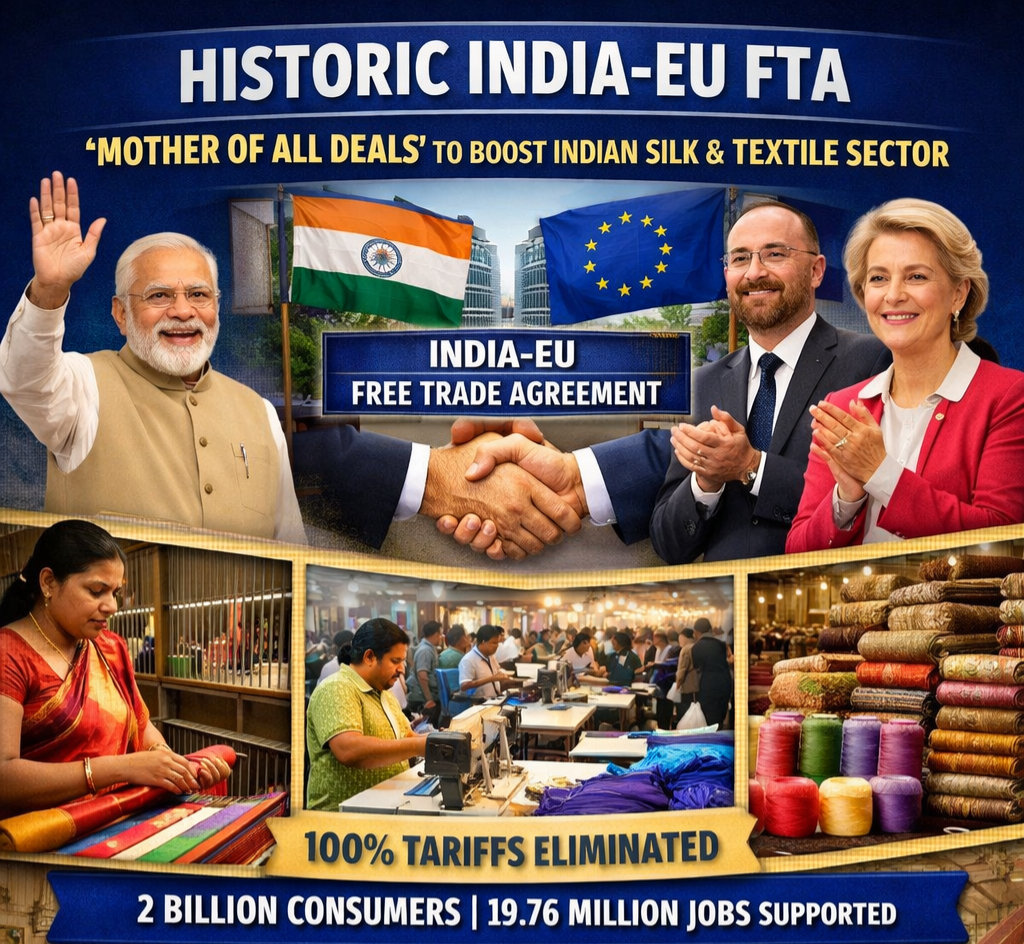
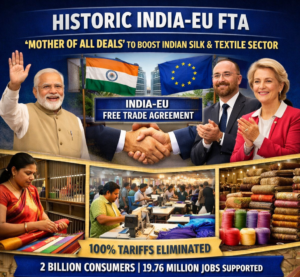
New Delhi. The Indian Silk Export Promotion Council (ISEPC), along with the entire silk fraternity of India and all Regional Silk Associations across the country, has extended its warmest congratulations to the Government of India on the historic finalisation of the India–European Union Free Trade Agreement (FTA) today. The congratulations were conveyed through Dr Bimal Mawandia, Chairman, ISEPC. Described by the EU President as the “mother of all deals,” this landmark agreement is expected to usher in an era of unprecedented growth and prosperity for the Indian textile sector, with the silk industry emerging as one of the prime beneficiaries and further strengthening India’s position as a global textile powerhouse.
This watershed agreement marks a significant milestone for the Indian silk and textile sector, which has long been the backbone of the country’s economy and a symbol of its rich cultural heritage. With the European Union being the world’s largest apparel importer, the agreement provides duty-free or preferential access to Indian manufacturers, enabling them to compete on a level playing field with countries such as Bangladesh and Vietnam. The elimination of tariffs on apparel tariff lines is expected to significantly boost the entire value chain of Indian silk textiles and apparel exports to the EU, resulting in a substantial increase in export volumes and revenues.
The importance of this agreement is immense, as the Indian silk and textile sector is a vital source of livelihood for approximately 19.76 million people. The deal is expected to safeguard existing livelihoods while generating new employment opportunities for women and youth, sericulturists, farmers, artisans, and SME entrepreneurs. One of the key highlights of the agreement is the elimination of import duties on nearly 100% of apparel and textile products, which currently attract tariffs of up to 10% in the EU. This will significantly enhance market access for Indian exporters across all EU member states and encourage manufacturers to focus on sustainability, design, and quality, in line with evolving EU market requirements.
The Indian Silk Export Promotion Council highlighted that India’s silk exports to the EU form a substantial and vital component of the country’s global textile trade, reflecting both India’s rich artisanal heritage and its industrial capabilities. The silk and allied silk sector, which sustains nearly 19.76 million people, currently exports silk and allied products to all major countries of the European Union.
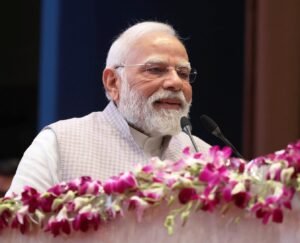
Announced during the India–EU Summit LIVE, Prime Minister Shri Narendra Modi described the pact as India’s biggest trade deal ever. Finalised after negotiations spanning more than two decades, this “mother of all deals” is expected to create a combined market of nearly 2 billion people.
Key Features of the India–EU FTA for the Textile Sector:
- Elimination of Tariffs: Import duties on 100% of apparel and textile products, which earlier went up to 10% in the EU, will be eliminated.
- Enhanced Competitiveness: Indian exporters will gain a level playing field against competitors that already enjoy preferential market access.
- Export Growth: Industry projections estimate that Indian apparel exports to the EU could grow by 20–25% year-on-year, compared to the current growth rate of around 3%.
- Expanded Market Access: Improved access across all EU member states, helping Indian exporters recover from the loss of earlier GSP benefits.
- Focus on Sustainability and Quality: The agreement encourages competition based on sustainability, design, and quality rather than price alone.
This “mother of all deals” is expected to significantly boost labour-intensive sectors, with textiles and silk being among the primary beneficiaries, while also promoting employment generation for women and youth.
The Indian Silk Export Promotion Council expressed its deepest gratitude to Hon’ble Prime Minister of India, Shri Narendra Modi, for his visionary leadership and tireless efforts in promoting the interests of trade, commerce, and industry. The Council expressed confidence that under his guidance, the benefits of this historic agreement will reach the smallest stakeholders, empowering the last artisan and entrepreneur in the value chain.
The Chairman, Dr Bimal Mawandia, Naresh Kumar Sadh, Vice Chairman, ISEPC, and Sanjeev Kumar Sharma, Executive Director, on behalf of the entire silk fraternity of India spread across the world, reaffirmed that this landmark agreement will not only safeguard traditional silk clusters and artisan livelihoods but also significantly enhance India’s presence in the EU market, fostering a stronger, more resilient, and enduring trade partnership between India and the European Union.